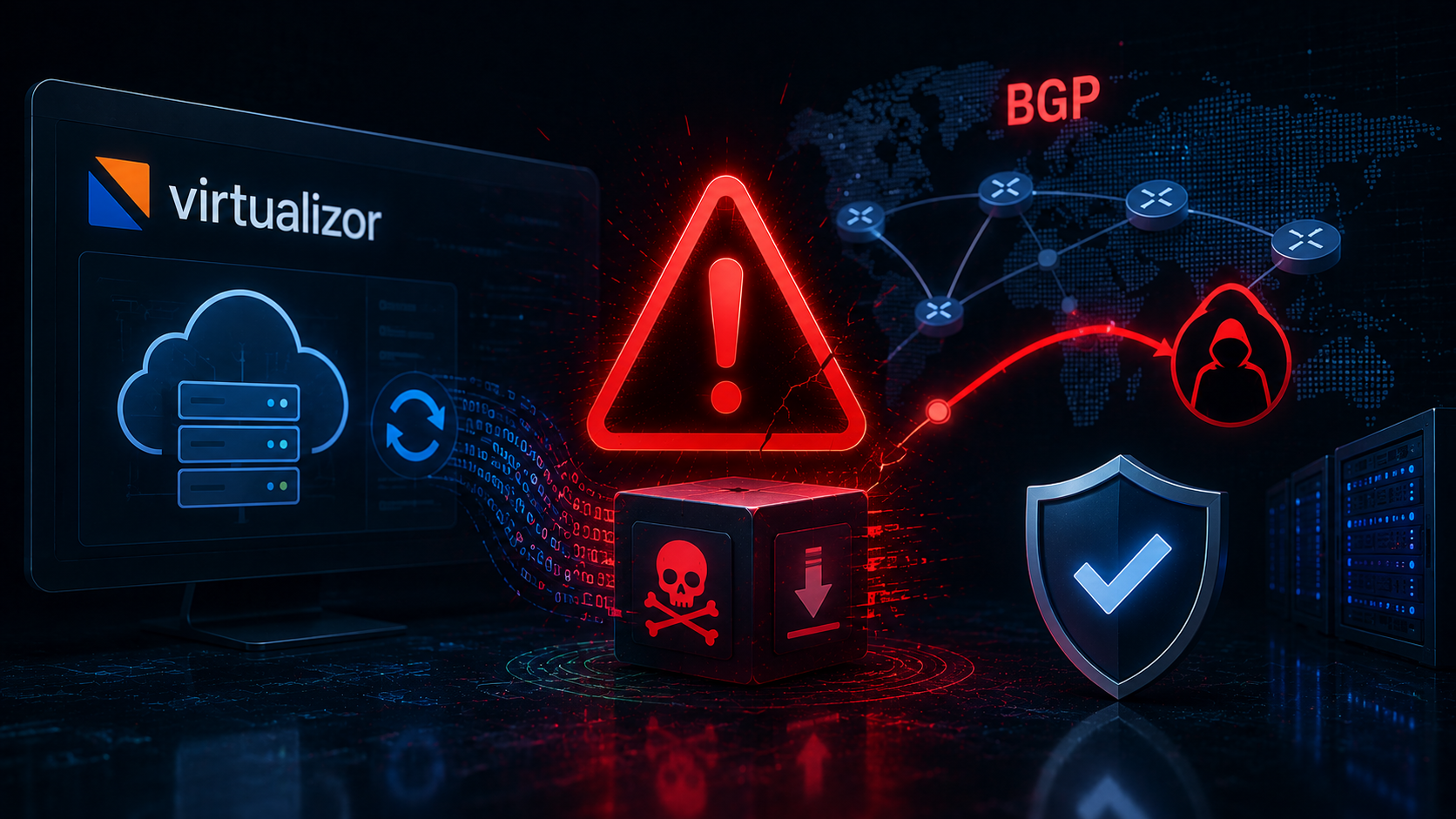
Virtualizor: when a BGP attack hits software update trust
A recently documented incident shows how BGP route hijacking can undermine trust in software update infrastructure. In this case, a limited number of Virtualizor installations may have received a malicious package during a defined time window.
Key takeaways for defenders
- Vector: BGP route hijacking affecting update infrastructure
- Impact: risk of installing malicious artifacts
- Exposure: time-bounded but high impact
Immediate response priorities
- Identify hosts that checked for updates during the incident window
- Hunt for suspicious services, scheduled tasks, and unexpected accounts
- Rotate sensitive API credentials and privileged access
- Upgrade to the vendor’s corrective release
- Monitor outbound traffic and unusual post-incident connections
Long-term hardening for update trust
- Enforce cryptographic package signing and strict client-side verification
- Use resilient and monitored update delivery channels
- Maintain a supply-chain incident response runbook
- Add network anomaly monitoring for critical routes and AS paths
Strategic message
Update security is not only an application problem. It also depends on network-layer resilience and end-to-end trust controls. Security and operations teams should treat this as a cross-functional priority.